
Top 10 Eva Deck Flooring Options for Global Buyers

Choosing the right Eva Deck Flooring can shape a boat’s comfort, safety, and appearance for years. Global buyers often compare foam density, surface texture, adhesive quality, color stability, and cutting accuracy before placing an order. A soft gray deck may feel comfortable under bare feet, while a darker teak pattern can create a warmer visual effect. Small details matter.

This guide examines ten Eva Deck Flooring options for boats, yachts, kayaks, swim platforms, and outdoor marine areas. Each option should be judged against its working environment, not only its catalog photographs. Saltwater exposure, intense sunlight, standing water, and frequent foot traffic can reveal weaknesses quickly. Buyers should also check thickness, closed-cell construction, drainage performance, temperature resistance, and installation requirements. Reliable suppliers should provide clear product specifications, sample materials, testing information, and consistent communication. That evidence is more useful than impressive marketing language.

Some preferences remain subjective. A thicker sheet is not always the best choice, especially where doors, hatches, or trim must move freely. Peel-and-stick installation can save labor, but surface preparation still decides the result. Even experienced installers may leave uneven edges or small adhesive gaps when working on complex curves. Careful measurement helps, though it does not remove every risk. The ten options below are selected to support practical comparison, helping international buyers balance comfort, durability, design, maintenance, and total purchasing value. Expect trade-offs. Good flooring rarely does everything perfectly.
Top 10 Eva Deck Flooring Options for Global Buyers

EVA Deck Flooring: Materials, Structure, and Core Performance

EVA deck flooring is usually built from closed-cell ethylene-vinyl acetate foam, not solid plastic. Its vinyl acetate content affects softness, flexibility, and surface feel. Cross-linked foam offers better dimensional stability, while laminated layers can improve appearance and bonding. A 2024 report from Grand View Research estimates the global EVA foam market will grow steadily through 2030, supported by marine, sports, and outdoor applications.

Structure matters more than color. A practical deck sheet often combines a textured top skin, a resilient foam core, and a pressure-sensitive adhesive layer. The core must resist water uptake, compression set, heat, and repeated foot traffic. ASTM D3575 can support cellular foam testing, while ASTM G154 helps evaluate accelerated UV exposure. However, laboratory results do not perfectly predict real boat conditions. Salt spray, wet footwear, sharp grit, and poor installation can change performance quickly.

Tips: Check foam density, thickness, peel strength, and compression recovery before ordering. Ask for test reports, not only marketing claims. A thicker pad is not automatically better; it may flex under furniture or trap heat. Leave expansion gaps around hatches and curved edges. I have seen attractive surfaces fail because the substrate was dusty or damp. Global buyers should also compare temperature ratings, adhesive compatibility, packaging protection, and replacement lead times. Small details matter.

Top 10 EVA Deck Flooring Options by Design and Application

Top 10 Eva Deck Flooring Options for Global Buyers

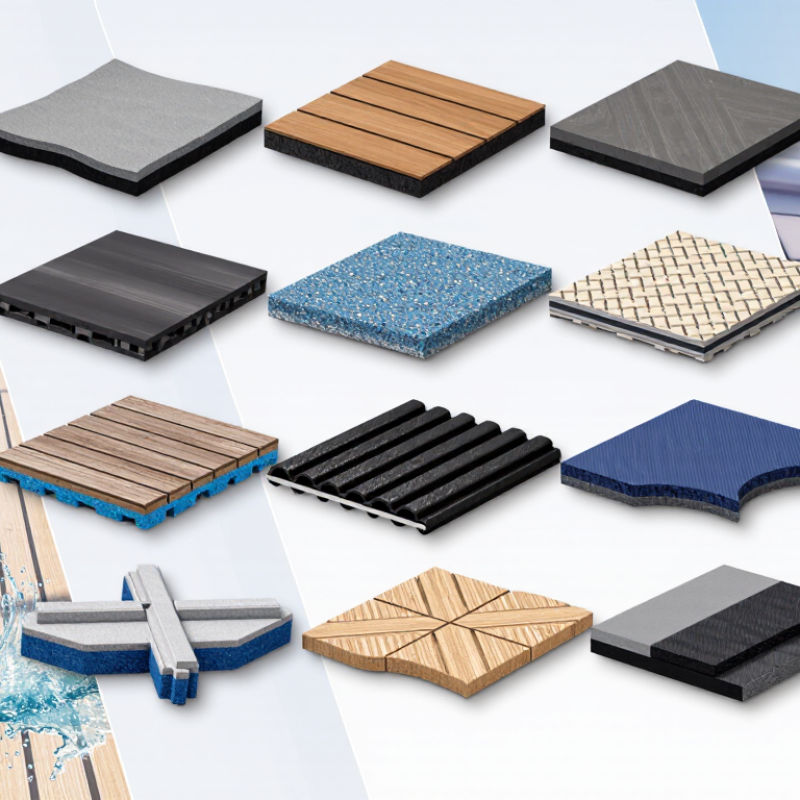
The best EVA deck flooring depends on design, traffic, and exposure. Teak-look EVA suits yachts and cruising boats, while solid gray fits rental fleets and workboats. Diamond-texture sheets improve wet-foot traction. Brushed finishes hide sand well. Camouflage patterns support fishing platforms. High-contrast borders help mark steps. Drainage-cut panels suit swim platforms. Lightweight peel-and-stick tiles simplify small repairs. Custom-cut helm mats protect high-wear areas. Extra-thick EVA cushions benefit stand-up paddleboards and tender decks.

These options respond to real operating conditions. The National Marine Manufacturers Association reports that more than 100 million Americans go boating annually. That figure shows why comfort, cleaning speed, and slip resistance matter beyond appearance. In field use, darker colors can become uncomfortably hot under direct sunlight. Lighter colors look cooler, but stains become obvious. No option wins every deck. Buyers should check closed-cell foam density, adhesive compatibility, UV stability, saltwater resistance, and dimensional tolerance before ordering. The International Organization for Standardization’s small-craft standards also reinforce the need for careful material and installation decisions.

Industry market reports commonly forecast steady growth for marine composites through 2030, driven by lighter structures and easier maintenance. EVA flooring benefits from that direction, although flooring-specific data remains limited and sometimes inconsistent. That limitation deserves attention. A teak pattern may look convincing in photos, yet poor embossing can trap grit. Adhesive failure is another practical risk, especially on poorly prepared aluminum or fiberglass. Installers should test a sample through heat, moisture, footwear, and repeated cleaning before committing to a full deck. Small details matter.

How to Compare EVA Deck Flooring for Different Climates

Top 10 EVA Deck Flooring Options for Global Buyers

How to Compare EVA Deck Flooring for Different Climates

Climate should guide every EVA deck flooring decision. Hot, humid regions demand closed-cell foam, strong bonding, and good drainage. NOAA’s 1991–2020 Climate Normals help buyers compare local temperature, rainfall, and humidity patterns. In tropical ports, dark flooring can become painfully hot under direct sunlight. Lighter colors usually reduce surface heat, but they may show stains faster. Small details matter.

Cold climates need flexible EVA that resists cracking during repeated temperature changes. Check the manufacturer’s tested service range, compression recovery, and dimensional stability. For intense sunlight, request accelerated weathering results under ASTM G154 or ISO 4892-3 procedures. The World Meteorological Organization’s State of the Global Climate 2024 confirms continued global warming, so older climate assumptions may be unreliable. Plan for harsher exposure.

Wet conditions require more than a textured surface. Ask for wet-friction results, ideally using recognized floor-testing methods such as ANSI/NFSI B101.1. Test a sample with seawater, sunscreen, and wet footwear. Real use is messy. Adhesive selection also changes by climate. High humidity can weaken installation if the deck is not dry, clean, and properly prepared. A common mistake is comparing foam thickness alone. Density, surface embossing, drainage gaps, and installation quality often matter more. No laboratory figure fully predicts local performance. A small trial panel can reveal problems before a full installation.

Top 10 Eva Deck Flooring Options for Global Buyers - How to Compare EVA Deck Flooring for Different Climates

Rank EVA Deck Flooring Option Typical Construction Typical Thickness Typical Density Water Absorption UV and Weather Performance Recommended Climate Slip-Resistance Profile Main Advantages Key Limitations Best-Fit Applications
1 Closed-Cell EVA Sheet with Brushed Texture Cross-linked, closed-cell EVA foam with a brushed or embossed surface 5–10 mm Approx. 90–150 kg/m³ Very low; closed-cell structure does not readily retain water Good when formulated with UV stabilizers; exposed colors may fade over time TropicalCoastalHumid High when dry or lightly wet Lightweight, comfortable underfoot, easy to cut, and suitable for irregular deck layouts Can compress under concentrated loads; surface may become slippery if contaminated by oil or algae Boat decks, swim platforms, fishing boats, and recreational marine flooring
2 EVA Foam with Teak-Style Groove Lines Closed-cell EVA panel with longitudinal grooves designed to imitate plank joints 6–10 mm Approx. 100–160 kg/m³ Very low; grooves assist surface drainage Good for marine exposure when UV-resistant pigments and protective additives are used SunnyTropicalMediterranean High with an appropriate embossed texture Decorative appearance, improved drainage, good thermal comfort compared with bare metal or fiberglass Grooves may collect dirt; dark colors can become hot under intense sunlight Yacht decks, cockpit floors, pontoon walkways, and premium recreational boats
3 High-Density EVA Marine Mat Higher-density closed-cell EVA foam with a fine embossed top surface 8–12 mm Approx. 140–220 kg/m³ Very low Very good under regular sunlight if the material includes UV stabilization High UVHeavy UseCoastal Very high for normal marine foot traffic Better dimensional stability, improved resistance to indentation, and longer service potential than low-density foam Higher cost and weight; may feel firmer than softer EVA grades Commercial workboats, charter boats, marinas, and high-traffic deck areas
4 Soft-Cushion EVA Deck Pad Lower-to-medium-density closed-cell EVA designed for comfort and impact cushioning 10–15 mm Approx. 70–130 kg/m³ Very low Moderate to good; requires UV-resistant formulation for permanent outdoor installation HotHumidRecreational High, subject to surface pattern and cleanliness Excellent comfort, shock absorption, noise reduction, and fatigue relief during long periods of standing More prone to compression and tearing from sharp objects or heavy point loads Stand-up paddleboards, leisure boats, swim platforms, and barefoot-use areas
5 Thin EVA Adhesive Deck Sheet Thin closed-cell EVA sheet with pressure-sensitive or marine-grade adhesive backing 3–6 mm Approx. 80–150 kg/m³ Very low Good when the adhesive and foam are rated for outdoor UV exposure ModerateLow-ProfileRefit Medium to high Low profile, simple installation, limited impact on hatch clearance, and relatively low material consumption Provides less cushioning and thermal insulation; substrate preparation is critical for bond strength Cabin soles, hatch covers, small boats, vehicle decks, and retrofit projects
6 EVA Drainage Mat with Open Grooves Closed-cell EVA panel with deeper channels or directional drainage grooves 8–12 mm Approx. 100–180 kg/m³ Very low; surface water can drain through channels Good to very good with UV-stabilized material and regular cleaning RainyMonsoonWet Decks High when the grooves remain free of debris Improves drainage, reduces standing water, and supports safer movement on frequently wet surfaces More difficult to clean than a flat sheet; grooves can hold sand, leaves, and fishing debris Fishing boats, tender decks, marina access areas, and rain-exposed walkways
7 Light-Colored EVA Deck Flooring Closed-cell EVA foam in light gray, beige, or similar heat-reflective colors 6–10 mm Approx. 90–170 kg/m³ Very low Good; lighter colors generally show less solar heat buildup than dark colors DesertTropicalHigh Solar Medium to high depending on embossing Lower surface temperature in strong sun, improved barefoot comfort, and reduced visual heat absorption Light colors show dirt, scuff marks, fish stains, and oil contamination more easily Sunny marinas, open boat decks, rooftop leisure areas, and warm-climate installations
8 Textured EVA Flooring for Cold Climates Flexible closed-cell EVA with a deeper non-slip embossing pattern 8–12 mm Approx. 110–190 kg/m³ Very low Good when the formulation remains flexible across the intended temperature range ColdTemperateSeasonal High with appropriate tread depth Maintains cushioning in cool conditions, provides insulation from cold substrates, and offers added traction Adhesive flexibility and installation temperature become important; hard contaminants can reduce traction Temperate-climate boats, cold-water fishing vessels, docks, and seasonal outdoor equipment
9 EVA Flooring with Reinforced Surface Layer Closed-cell EVA core with a denser or more abrasion-resistant top skin 6–10 mm Approx. 150–250 kg/m³ Very low Very good when the surface layer includes UV and abrasion protection CommercialHigh TrafficAll-Season Very high for regular pedestrian traffic Improved wear resistance, better resistance to scuffing, and more consistent appearance over time Less soft than standard EVA; cuts and repairs may be more visible or more difficult Charter fleets, commercial vessels, marina facilities, and frequently used boarding areas
10 Custom-Cut EVA Deck Flooring Kit Pre-cut closed-cell EVA panels based on deck templates, with optional edge bevels and fitted seams 5–12 mm Approx. 90–220 kg/m³ Very low Depends on the selected EVA grade, color, surface texture, and adhesive system Complex LayoutsRefitGlobal Use Depends on selected texture Reduces on-site cutting, improves appearance, supports accurate fitting, and simplifies installation planning Template errors can cause fitting problems; replacement panels may require matching the original batch Custom boats, yacht refits, irregular decks, hatches, consoles, and multi-zone flooring projects

Comparison note: Values are typical indicative ranges for closed-cell EVA deck flooring and can vary by foam formulation, surface treatment, color, adhesive system, and manufacturing process. For final selection, verify UV exposure ratings, operating temperature, abrasion resistance, slip testing, adhesive compatibility, and local marine-safety requirements.

Installation, Maintenance, and Lifespan Considerations

Choosing among the top 10 EVA deck flooring options requires more than comparing colors and prices. Installation conditions often decide performance. Before fitting, measure the deck twice, remove old adhesive, and clean the surface with a suitable degreaser. It must be dry, smooth, and free from oil. Uneven fiberglass can create soft spots beneath the flooring. That detail is easy to miss.

Closed-cell EVA foam usually cuts cleanly with a sharp utility knife. Replace dull blades frequently. Apply marine-grade adhesive evenly, especially around corners and hatch edges. Leave expansion gaps where the manufacturer recommends them. Direct sunlight can heat dark flooring significantly, so installation during cooler hours is safer. I once rushed a fitting job on a warm afternoon, and a small lifted edge appeared within weeks. That mistake changed my preparation routine.

Maintenance is simple, but not careless. Rinse salt, sand, and spilled drinks with fresh water after use. A soft brush removes dirt without flattening the texture. Avoid harsh solvents, wire brushes, and pressure washing at close range. Inspect seams monthly, particularly around high-traffic steps and seat bases. Lifespan commonly depends on sunlight, foot traffic, cleaning habits, and adhesive quality. Well-installed flooring may serve for several years, but no material lasts indefinitely under constant UV exposure. Pale colors can reduce heat buildup, although they may show stains sooner. Replacement planning should include spare sections, because matching an aged surface is rarely perfect.

Top 10 EVA Deck Flooring Options for Global Buyers

Installation, maintenance, and lifespan considerations based on typical closed-cell EVA marine flooring applications.

The comparison uses typical values for a 10 m² installation. Installation time depends on surface preparation, cutting, adhesive application, and fitting complexity. Expected service life is commonly influenced by UV exposure, saltwater, temperature changes, cleaning frequency, and foot traffic. Regular rinsing with fresh water and mild soap helps preserve EVA foam surfaces.

Global Buying Factors: Quality, Compliance, Cost, and Shipping

For global buyers, EVA deck flooring should be judged beyond its color and surface pattern. Quality begins with stable closed-cell foam, even density, accurate cutting, and adhesive that remains firm after heat exposure. Ask for batch samples, technical data, and test records before approving a large order. The sheet should recover after compression and resist water absorption near seams. Small gaps become serious problems on a wet deck. In practice, a sample can look excellent yet reveal weak bonding during installation. That is worth checking.

Compliance is not a decorative certificate. Confirm material composition, restricted-substance declarations, fire or slip-performance requirements, and destination-market documentation. Requirements differ between recreational boats, commercial vessels, and outdoor platforms. Request traceable production dates and consistent labeling. Independent testing adds confidence, although it increases lead time and cost. A supplier who answers vaguely creates avoidable risk. Do not rely on copied reports. Verify the scope, test method, and sample identity.

Cost should include tooling, cutting waste, packaging, duties, inland delivery, and possible rework. The lowest quotation may become expensive after warped sheets or mismatched colors arrive. Compare landed cost, not unit price. For shipping, confirm carton dimensions, moisture protection, pallet strength, and loading photos. EVA foam is light, but bulky packaging can raise freight charges. Sea freight lowers cost but needs longer planning; air freight suits urgent samples, not routine volume. Build a realistic buffer. My own purchasing reviews often underestimated inspection time. That mistake still deserves correction.