
Top Motor Mechanical Engineering Trends in 2026

Motor mechanical engineering is entering 2026 under pressure to deliver more power with less energy, mass, and downtime. The U.S. Department of Energy’s industrial motor systems assessment estimates that motor-driven systems use about 68% of electricity consumed by U.S. industry. That figure is a reminder: small design gains can matter at plant scale. They can also disappear if a motor, drive, and load are poorly matched.

Ned Mohan, an IEEE Fellow and author of Electric Machines and Drives, emphasizes that machine performance depends on the interaction between the motor and its drive. His systems-level perspective is increasingly relevant. Engineers are refining inverter-ready insulation, rotor and bearing designs, thermal paths, and high-speed operation. Digital twins and condition monitoring are also moving from pilot projects toward practical maintenance tools. But sensors do not fix weak engineering. Data quality still matters.

Electrification adds momentum. The International Energy Agency reported more than 17 million electric car sales in 2024, exceeding 20% of global new-car sales. That expansion strengthens demand for compact traction motors, efficient cooling, and manufacturable designs. Material choices will face closer scrutiny, too, including rare-earth use, repairability, and supply resilience. Progress will not look identical across sectors. A factory pump and a vehicle traction motor have different loads, risks, and service lives. The trends ahead are promising, but trade-offs remain. This outline examines where performance gains are credible, where adoption is uneven, and what engineers should question before calling a design “next-generation.”
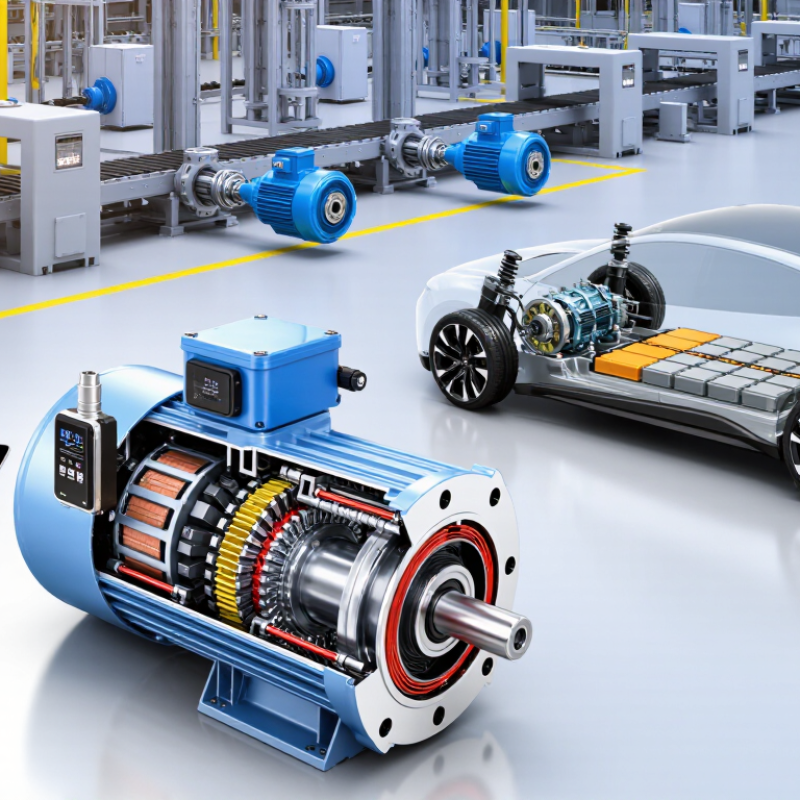
Top Motor Mechanical Engineering Trends in 2026

Core Principles Shaping Motor Mechanical Engineering in 2026

Top Motor Mechanical Engineering Trends in 2026

Motor engineering in 2026 is increasingly judged as a system problem, not a peak-efficiency contest. The International Energy Agency’s 2011 report, Energy-Efficiency Policy Opportunities for Electric Motor-Driven Systems, estimates that these systems use about 45% of global electricity. That scale makes operating conditions matter. A motor must deliver torque across its real speed range while managing heat, vibration, and mechanical losses. Efficiency figures alone can hide poor performance under partial load.

Mechanical fundamentals remain decisive. Rotor balance, shaft alignment, bearing loads, and air-gap consistency affect noise, wear, and service life. Small tolerances matter. The U.S. Department of Energy’s Improving Motor and Drive System Performance sourcebook reports that motor-driven systems account for roughly 70% of U.S. manufacturing electricity use. This makes maintenance and system matching practical engineering priorities, not minor details. Yet that broad figure does not describe every plant; duty cycles and operating environments vary sharply.

Engineering teams are also using sensors and digital models to track temperature, vibration, and load changes. These tools can flag a developing bearing problem before it becomes a shutdown, but they cannot replace sound inspection or accurate measurements. More data is not always better. Engineers still need to question whether a model reflects the actual shaft, mounting stiffness, and cooling path. That judgment is imperfect, and it should be revisited when field results disagree with design assumptions.

Advanced Materials and High-Efficiency Motor Design

Motor design in 2026 is increasingly shaped by materials that manage heat, weight, and magnetic loss. Electrical steel with thinner laminations can reduce eddy currents, though processing quality matters as much as the material specification. Heat still wins. A poorly cooled core can erase the efficiency gains of a carefully selected alloy.

For compact motors, engineers are exploring high-performance magnets, copper windings, and improved insulation systems. Each choice brings trade-offs. A denser winding may increase torque, but it can also restrict airflow and raise operating temperatures. In practical design reviews, checking hot spots near end turns and rotor surfaces can reveal problems that a single efficiency figure hides. Small gains matter, but only when the motor can sustain them under real loads.

Advanced polymers and ceramic coatings can help insulation withstand heat, vibration, and repeated thermal cycling. Yet laboratory results do not always predict service life; manufacturing variation and maintenance conditions still matter. Not every alloy fits. Designers should compare material cost, recyclability, and repair needs alongside performance. A motor that is efficient on a test bench but difficult to cool or maintain may not be the better choice.

Digital Manufacturing and Precision Assembly

Top Motor Mechanical Engineering Trends in 2026

Digital manufacturing is bringing tighter control to motor assembly. Sensors can track press-fit force, shaft runout, and bearing temperature as parts move along the line. When readings drift, engineers can pause production before a small variation becomes a noisy motor or premature failure. Deloitte’s 2024 Smart Manufacturing Survey found that 86% of surveyed manufacturing executives expect smart manufacturing to drive competitiveness within five years. The International Federation of Robotics reported 4,281,585 industrial robots operating worldwide at the end of 2023. These figures point to growing investment, but automation alone does not guarantee accuracy.

Tips: Record torque, alignment, and test results against each motor’s serial number. Check sensor calibration regularly. Small errors matter.

Precision assembly works best when digital records connect design tolerances with actual shop-floor measurements. A digital model can help teams compare expected vibration with test-bench results, then adjust tooling or assembly steps. This is useful when balancing rotors or aligning housings, where fractions of a millimeter can affect performance. Still, dashboards can create false confidence if measurements are incomplete or poorly interpreted. Human checks remain necessary, and older equipment may not provide clean data. That gap deserves attention, not a glossy chart.

AI-Enabled Monitoring and Predictive Maintenance

In 2026, AI-enabled monitoring is becoming a practical tool for improving motor reliability, not a substitute for sound engineering. Sensors can track vibration, bearing temperature, electrical current, and acoustic changes while a motor runs under real loads. Patterns matter more than single readings. A warm bearing after startup may be normal; a repeated temperature rise during steady operation deserves inspection.

Predictive models compare live signals with an asset’s operating history and flag unusual changes. Maintenance teams can schedule checks during planned downtime, then inspect lubrication, alignment, cooling, or bearing wear. Useful alerts should show their evidence, such as a growing vibration peak near a known shaft frequency. Trust takes time. Poor sensor placement, loose connections, and changing workloads can distort data, while models may produce false alarms.

Experienced technicians still matter. An alert is a prompt, not a diagnosis. Teams should verify it against measurements, maintenance records, and a physical inspection before replacing parts. Early deployments can be uneven. Some motors have years of consistent records; others have gaps, making predictions less certain. That limitation should be reported plainly.

Top Motor Mechanical Engineering Trends in 2026: AI-Enabled Monitoring and Predictive Maintenance

Illustrative motor-monitoring example showing vibration velocity rising over time, with an AI-generated forecast approaching a site-configured alert threshold. The data are simulated, not field measurements; thresholds should be set for the specific motor and installation.

Vibration is shown as overall RMS velocity in mm/s. Early detection of a sustained increase can help teams plan inspection before an unplanned outage.

Sustainable Motors and Circular Engineering Practices

In 2026, sustainable motor engineering is moving beyond efficiency ratings. Design teams are considering how motors can be repaired, disassembled, and reused. This changes choices made early in development, including housing materials, fasteners, and winding insulation. Small details matter. A casing with accessible bolts can be easier to service than one sealed with permanent adhesive.

A repairable motor may use replaceable bearings, standard fasteners, and clear disassembly instructions. Engineers can also design components for material recovery, rather than mixing metals and plastics that are difficult to separate. Yet durability and circularity do not always align neatly. A coating that protects a rotor from corrosion may complicate later material separation. It is messy. Each design needs testing under realistic heat, vibration, and maintenance conditions.

Circular engineering also depends on what happens after a motor leaves the factory. Service records can reveal which parts fail most often and whether replacement extends useful life. Recovered copper and steel may reduce demand for virgin materials, but collection and sorting still require energy. Designers should measure these trade-offs instead of treating “recyclable” as proof of sustainability. Data from field repairs can help, though results may vary between operating environments.